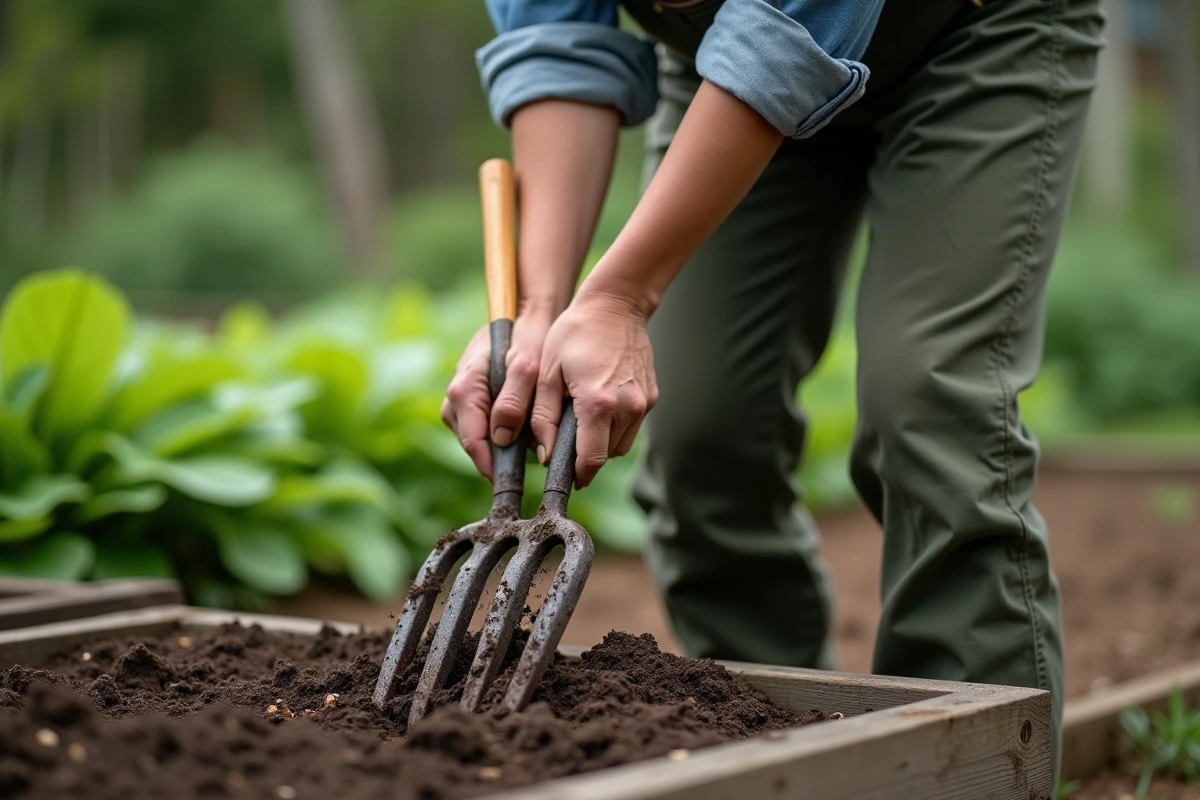
The grelinette is not just a decompaction lever. On soil that is already structured by cover crops or permanent mulching, a systematic annual pass can degrade what you are trying to preserve. We start from this technical observation to address the choice and use of this tool in an organic vegetable garden.
Carbon Mineralization and Frequency of Use in the Vegetable Garden
Repeated decompaction with the grelinette increases the oxygenation of the surface horizons. On soils that are already well-aerated or rich in organic matter, this influx of oxygen accelerates carbon mineralization. The INRAE report “Agroecology and Soil Management” from 2022 confirms: repeated passes increase organic carbon losses, especially without permanent cover.
In hot climates or during prolonged droughts, the phenomenon intensifies. Decompacting bare soil in the middle of summer exposes organic matter to rapid degradation. The grelinette is not a tool to be used out of seasonal reflex.
Feedback from ITAB-INRAE trials (conference “Soil-Saving Cultivation Systems,” 2023) suggests a pass every two to three years on already structured plots, combined with cover crops between growing cycles. On a vegetable garden bed well-mulched for several seasons, spacing out interventions better preserves soil life than annual grelinette use.
We recommend testing soil resistance before each season: push a metal rod to the depth of a tine. If it penetrates without notable effort, using the grelinette is unnecessary. Reserve it for areas compacted by foot traffic or new cultivation zones.
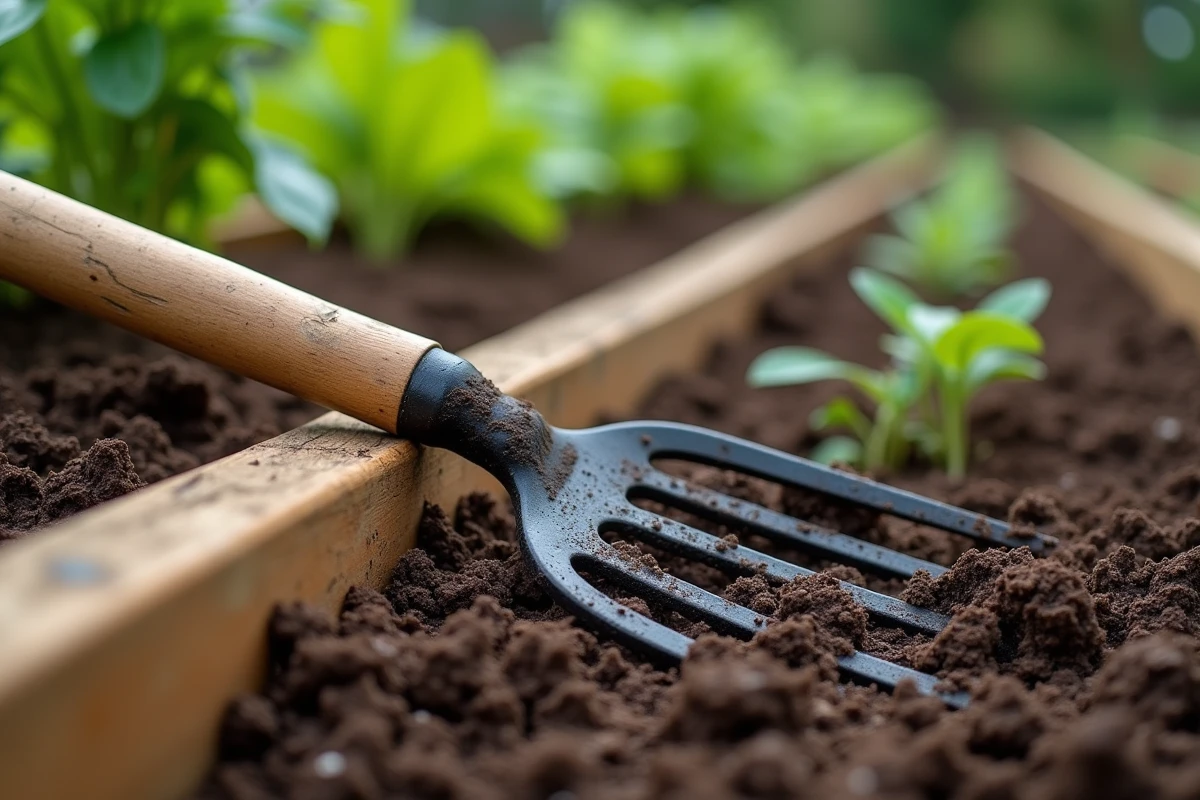
Tines, Steel, and Geometry: Technical Criteria for a Durable Grelinette
The number of tines determines the working width, but also the effort required. Three tines are suitable for heavy soils (clay, compact silt) where the resistance per tine is high. Five tines cover a width close to a standard bed, but only on already worked or sandy soils.
Four tines represent the most versatile compromise for a diverse vegetable garden. Detailed references and comparisons are available on grelinette-warrior.com, especially to cross these criteria with soil types.
Curvature and Section of the Tines
Slightly curved tines facilitate the lever effect during the backward tilt. Straight tines penetrate hard soil more easily but require extra effort for extraction. In an ecological vegetable garden where the soil improves over the seasons, curved tines become more relevant over time.
The round section slides better between roots and stones. The square section offers more rigidity. On stony soil, we prefer the round section to avoid blockages and tine twisting.
Quality of Steel and Handle Attachment
Hardened steel resists bending on stony soil without deforming. Entry-level models use softer steel that bends after a few seasons of intensive use. Ensure that the tines are welded onto a solid crossbar and not simply fitted by friction.
- Tines made of hardened steel or boron steel: superior resistance to deformation and corrosion compared to standard steels
- Welded monobloc crossbar: prevents mechanical play between the tines and the frame after a few hundred cycles
- Handles made of hardwood (ash, beech) or composite: ash absorbs vibrations better, composite does not break in cold weather
- Handle height suitable for the user’s size: elbows should remain slightly bent in the working position
Grelinette Technique: Correct Movement and Common Mistakes
Grelinette use relies on a lever movement, not a lifting effort. Push the tines vertically with your body weight, one foot on the crossbar, then tilt the handles towards you without lifting the tool. The soil cracks and aerates deeply without being turned over.
The most common mistake is pulling the handles upwards after tilting. This action lifts clods, disrupts soil layering, and strains the lower back. The correct movement stops at the tilt: the tines naturally rise when you step back for the next pass.

Adapting the Movement to Soil Type
On heavy clay, work in well-drained soil (neither waterlogged nor dry). Soil that is too wet sticks to the tines and compacts instead of cracking. Soil that is too dry resists penetration and breaks into clumps.
- Clay soil: wait two to three days after rain, tilt with low amplitude to crack without smoothing
- Sandy soil: quick pass, low resistance, prefer a grelinette with five tines to cover more area
- Stony soil: advance with small successive penetrations, do not force if a tine hits a stone
On a permanently mulched vegetable garden, pull back the mulch before passing. Grelinetting through thick mulch traps carbonaceous material deep down, which can create pockets of anaerobic fermentation harmful to roots.
Grelinette and Soil Cover: A Technical Pair to Synchronize
The grelinette makes the most sense when it is part of a coherent cultivation plan. Grelinetting a bed and then leaving it bare accelerates erosion and compaction. The pass should be immediately followed by sowing cover crops, mulching, or planting.
In organic vegetable growing, the most effective sequence is to mow the cover crop, grelinette, and then directly install the next crop in one go. This chaining limits the time of bare soil exposure to just a few hours.
The grelinette is not a substitute for biological soil management. Earthworms, cover crop roots, and the decomposition of mulch continuously structure the horizons. The tool is used occasionally, when compaction exceeds the capacity for natural restructuring. In a well-managed ecological vegetable garden, its use decreases over the years, indicating that the soil is regaining autonomous porosity.