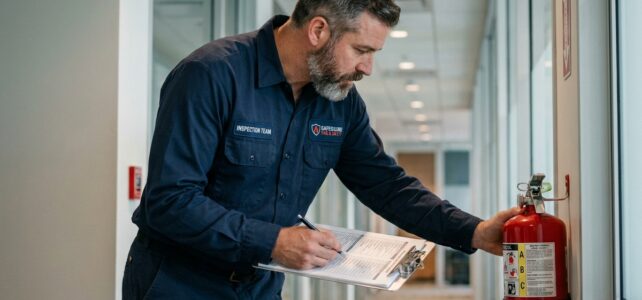
Choosing a fire safety company involves ensuring regulatory compliance for a building, protecting occupants, and maintaining business continuity in the event of a disaster. Several technical criteria help distinguish a reliable provider from a less competent one. This article measures the gaps between market offers on the points that weigh most heavily in the decision: scope of services, ability to collaborate with an internal referent, and documentation traceability.
Internal fire referent and external provider: a relationship often overlooked
Most comparisons focus on the technical skills of the provider. They overlook a key point: the employer’s responsibility remains engaged even in the case of outsourcing. Eurofeu reminds us that the internal fire safety manager plans inspections, maintains the safety register, organizes evacuation drills, and coordinates staff training.
A provider who ignores this role delivers technical reports without linking them to the DUERP or the establishment’s safety register. The internal referent then has to compile the data themselves before each inspection.
During selection, it is essential to check if the provider offers a shared reporting process, accessible tracking tools for the referent, and coordinated updates of the DUERP after each intervention. This criterion quickly filters candidates: a fire safety company that structures this documentary interface demonstrates an organizational maturity that others do not reach.

Scope of fire safety services: comparison grid
The scope varies significantly from one provider to another. Some limit themselves to the maintenance of fire extinguishers, while others cover the entire fire safety system (SSI), smoke extraction, employee training, and preparation for evacuation drills. The table below summarizes the services to compare.
| Service | Specialized SSI Provider | Generalist Provider |
|---|---|---|
| Initial diagnosis and SSI diagram | Included, tailored to the type of building (ERP, IGH, tertiary) | Rarely offered or subcontracted |
| SSI maintenance (NF S61-933 standard) | Contractual follow-up with complete traceability | Occasional interventions, variable traceability |
| Natural and mechanical smoke extraction | Covered internally | Often subcontracted to a third party |
| Training and evacuation drill | Annual program with report to the referent | Ad-hoc training upon request |
| Update of the safety register | Integrated into the contract | Client’s responsibility |
| On-call service and intervention time | Announced contractual timeframe, on-call possible | No guaranteed timeframe |
A specialized provider covers on average twice as many areas as a generalist on the same contract. The gap is especially pronounced in traceability and coordination with the internal referent, two elements that weigh heavily during safety commission visits.
NF S61-933 standard and traceability of interventions: what separates providers
The NF S61-933 standard governs the maintenance of fire safety systems. It requires documented periodic checks, tracking of anomalies, and compliance reinstatement within defined timeframes. All providers mention it in their marketing materials. Few fully comply.
The gap can be measured on three concrete points:
- The detailed intervention report: a rigorous provider delivers a document identifying each piece of equipment checked (detectors, alarm, signage, smoke extraction system), the anomalies noted, and the corrective actions taken.
- The update of the safety register after each visit, with timestamp and technician’s signature, allows the referent to present a complete file during an inspection.
- The projected maintenance plan, communicated at the start of the contract, sets intervention dates for the year. It prevents oversights and facilitates coordination with local emergency services in the event of a planned evacuation drill.
Requesting a sample intervention report before signing a contract remains the most direct method to assess a provider’s rigor. A vague or generic report indicates insufficient traceability.
SSI diagram: a strategic lever for SMEs
A well-designed fire safety system diagram goes beyond mere compliance. It maps all devices (detection, alarm, smoke extraction, controls) and their interactions. For an SME, this diagram becomes a management tool for business continuity, not just a technical document filed away in a binder.
When choosing a provider, verifying their ability to produce or update this diagram distinguishes a technical operator from a partner capable of supporting the business in the long term.

Evacuation drills and staff training: markers of seriousness
Employee training and evacuation drills are among the employer’s obligations. A provider who incorporates these aspects into their offer simplifies management for the fire referent.
Points to check before committing:
- Does the provider organize evacuation drills with a scenario tailored to the building (location of assembly points, role of the evacuation leader, management of people with reduced mobility)?
- Do they offer practical training on using extinguishers and the alarm system, or do they limit themselves to theoretical presentations?
- Is the exercise report sent to the referent with identified areas for improvement?
A provider who documents each exercise and derives a concrete action plan adds measurable value. Successive reports allow for demonstrating continuous improvement during regulatory inspections.
Players in the fire safety sector: identifying suitable profiles
The fire safety market includes a variety of profiles, from specialized design offices to installers-maintainers, as well as companies positioned on a broader spectrum. dpsa sécurité, for example, is a company whose activity falls within the field of security, as indicated by its online presence via the site dpsa-securite.fr.
In a structured selection process, identifying players whose positioning matches the specific needs of the building in question (ERP, tertiary, industrial) remains the most effective approach. Cross-referencing several detailed quotes on the same scope allows for comparing not only prices but especially the level of traceability and support offered by each provider.
The choice of a fire safety provider relies less on the displayed price than on their ability to document their interventions and collaborate with the internal referent. A comprehensive scope, from SSI diagnosis to staff training, reduces the risk of non-compliance.
A contract that includes the update of the safety register and a projected maintenance plan serves as the most reliable filter before any signature. Comparing the typical intervention reports of each candidate allows for verifying this documentary rigor.