
You pour a liquid into a measuring jug, the recipe calls for 80 ml, and your container is marked only in centilitres. The answer takes one simple calculation: 80 ml is exactly 8 cl. Divide the millilitres by 10—no rounding, no approximation. This fixed ratio between millilitres and centilitres applies to all liquids, all ingredients and all temperatures.
The conversion itself isn’t what causes problems in the kitchen. It’s what happens next, especially when volume is confused with weight, or when a recipe from another country uses cups whose capacity varies from one country to another.
Foreign cups and 80 ml: why the equivalent varies by country
An American recipe calling for ⅓ cup means about 79 ml, or almost 8 cl. You might think that’s close enough. But a Japanese cup has a different standard capacity: a Japanese “cup” holds 200 ml, making one third about 67 ml, or 6.7 cl.
To find out what 80 ml is in cl in an international recipe, you first need to identify the cup size used by the author.
The North American cup holds 236 ml, the metric cup (used in Australia and some Commonwealth countries) holds 250 ml, and the Japanese cup holds 200 ml. If a recipe gives a fraction of a cup without specifying the standard, the difference can be more than a centilitre. In a sauce base or custard mixture, that difference can affect the consistency.
- American recipe: ⅓ cup = about 79 ml, or 7.9 cl—very close to 8 cl
- Australian recipe (metric cup): ⅓ cup = about 83 ml, or 8.3 cl
- Japanese recipe: ⅓ cup = about 67 ml, or 6.7 cl
In practice, if the recipe comes from an English-language blog that doesn’t specify a country, assume it uses the 236 ml American cup. If it comes from an Australian or New Zealand website, use 250 ml.
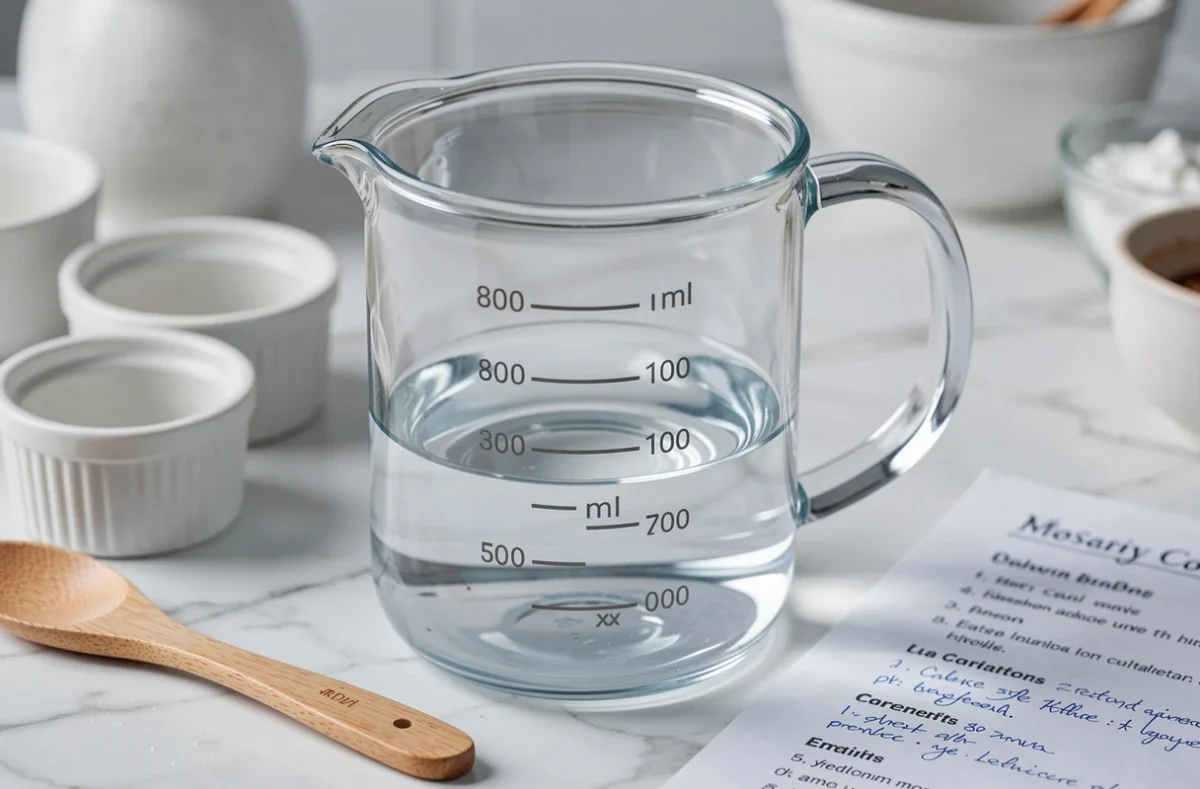
Converting 80 ml to cl, cm³ and grams: three units, three uses
Converting ml to cl is a straightforward decimal calculation. One centilitre contains 10 millilitres, and one litre contains 100 centilitres. Simply divide by 10 to convert ml to cl. There’s no variable conversion factor or table to memorise.
Another useful way to express a measurement in the kitchen or laboratory is in cubic centimetres: 80 ml is also 80 cm³. A millilitre and a cubic centimetre represent the same volume. Some older measuring jugs and professional baking tools are marked in cm³ rather than ml.
Volume and mass: the common confusion with grams
Saying that 80 ml weighs 80 g is only true for pure water, which has a density of 1 g/ml. For any other ingredient, 80 ml does not weigh 80 grams. Olive oil is less dense and weighs less. Honey is denser and weighs more.
When a recipe calls for 80 ml of milk, the weight is very close to 80 g because milk has a density similar to water. For 80 ml of packed flour or icing sugar, the difference becomes significant, and the weight varies depending on how firmly it is packed.
The European directive on units (Directive 80/181/EEC, published on 20 December 1979) permits the litre and its decimal multiples as legal units, but says nothing about conversions to mass, which depend on the substance.
The rule to remember: converting ml to cl never depends on the liquid, but converting to grams does.
Measuring 80 ml without a measuring jug: everyday utensils and their limitations
Not everyone has a measuring jug to hand. You can approximate 80 ml using tablespoons. A level tablespoon holds about 15 ml. Five tablespoons give you 75 ml, a little short. Five tablespoons plus one teaspoon (about 5 ml) give you 80 ml.
A standard mustard glass often holds around 200 ml. Filling it to just under halfway gives you roughly 80 ml, but the margin of error is greater than with a graduated measuring jug.
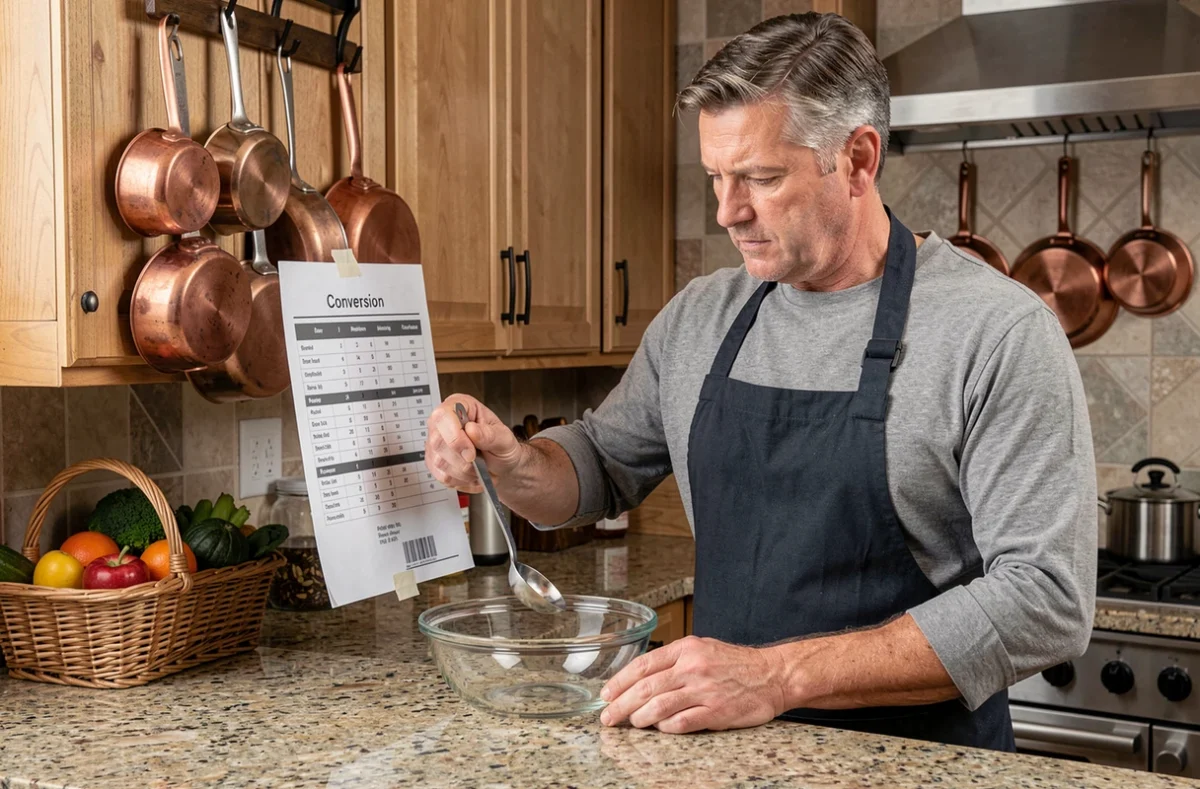
Read the measurement at the right height
Place the container on a flat surface and read the liquid level at eye height, not from above. Looking down distorts the reading because of the meniscus (the curve at the liquid’s surface). Reading at eye height reduces measurement error, which matters most for recipes where proportions are critical: thin crêpe batter, ganache or poaching syrup.
For soup or a marinade, a difference of a few millilitres won’t affect the result. For a flan mixture or mirror glaze, every centilitre counts.
Quick conversion table for measurements around 80 ml
This table covers volumes close to 80 ml, which are among the most common in baking and everyday cooking recipes.
| Millilitres (ml) | Centilitres (cl) | Cubic centimetres (cm³) |
|---|---|---|
| 50 ml | 5 cl | 50 cm³ |
| 60 ml | 6 cl | 60 cm³ |
| 70 ml | 7 cl | 70 cm³ |
| 80 ml | 8 cl | 80 cm³ |
| 90 ml | 9 cl | 90 cm³ |
| 100 ml | 10 cl | 100 cm³ |
| 125 ml | 12.5 cl | 125 cm³ |
| 150 ml | 15 cl | 150 cm³ |
The cm³ column may seem redundant, but it saves you an extra search when you come across instructions for a siphon or silicone mould marked in cubic centimetres.
Converting 80 ml to cl is simple arithmetic. What deserves attention is the context in which you use the measurement: checking where the recipe comes from, distinguishing volume from mass, and reading the liquid level correctly will do more to ensure a successful dish than the conversion itself.