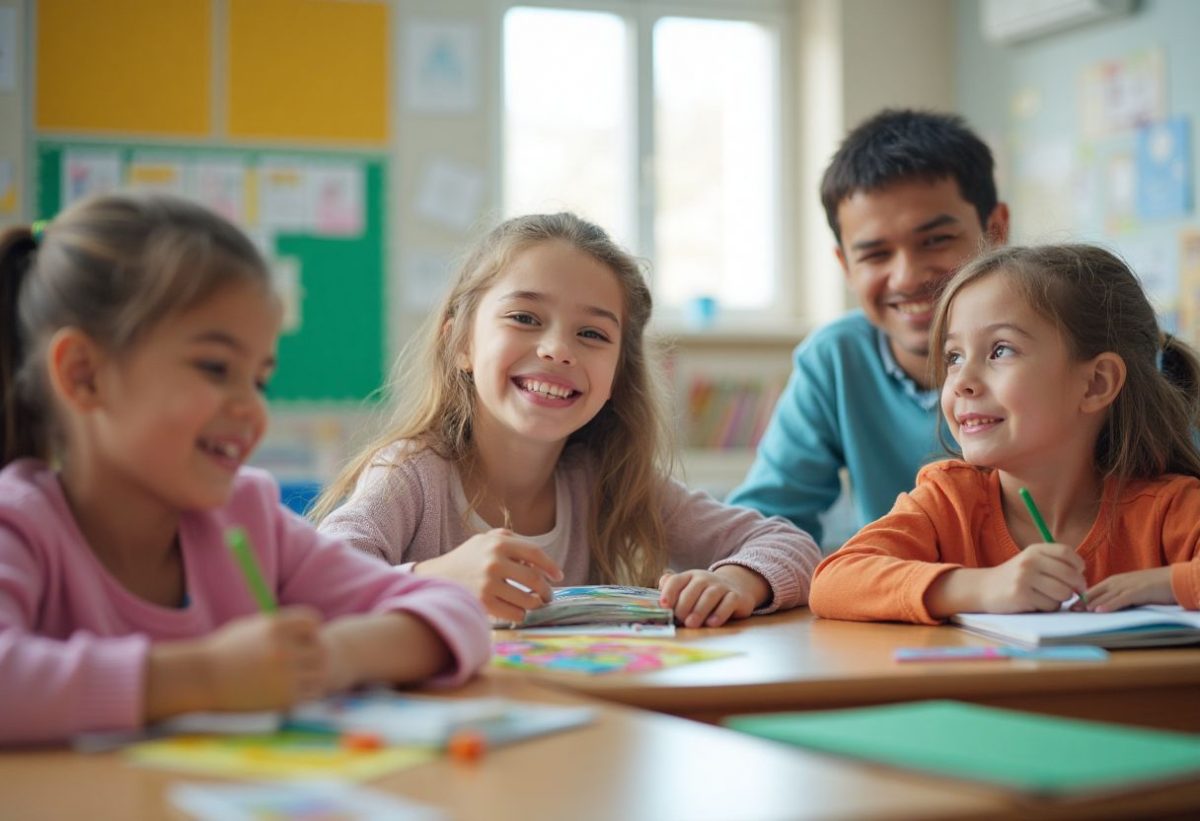
Each school year is a new adventure for children, full of discoveries and learning. From kindergarten to elementary school, the educational journey is marked by essential acquisitions. These years are crucial for laying the foundations of each child’s development, both academically and personally. Parents and teachers work together to foster a stimulating and caring environment, allowing children to thrive fully.
Fundamental Skills
Language Learning
Language is a fundamental tool that kindergarten and elementary school commit to developing in children. From kindergarten, children are encouraged to use language in all its dimensions, enriching their vocabulary and getting acquainted with phonetics. This solid foundation is essential for better understanding the subtleties of written and oral language.
Mastery of Writing
Learning to write is a key step in the early learning cycle. From kindergarten, children practice tracing letters, thus developing their motor skills and hand-eye coordination. In elementary school, they progress to writing simple sentences, an essential skill for written communication. Children also learn to structure their thoughts and express their ideas clearly and coherently.
Reading Practice
Reading opens the door to a world of knowledge and imagination. Children learn to recognize common words and understand texts suited to their level. This skill, integrated from the kindergarten section, is reinforced throughout elementary school, allowing them to read for pleasure and discover new stories and ideas.
Mathematics in Elementary School
Basic Operations
Mathematics is often perceived as a challenge, but it is fundamental for children’s intellectual development. Learning addition, subtraction, multiplication, and division begins early, with a playful and progressive approach. Helping your child love mathematics can be enriching for both them and you.
Geometry and Measurement
Children discover geometric shapes and learn to understand units of measurement. These concepts are essential for developing spatial awareness and the ability to solve problems related to everyday life. Solving mathematical problems also sharpens their logic and critical thinking.
Knowledge of the World
History Concepts
The elementary school history and geography curriculum introduces students to local history and great civilizations. This approach helps them understand the world they live in and appreciate cultural and historical diversities. Children thus learn to question the world and develop their intellectual curiosity.
Scientific Education
Observing natural phenomena and discovering the basic rules of physics are at the heart of scientific education. This knowledge contributes not only to general culture but also to understanding the laws governing our environment. It is an invitation to appreciate the beauty and complexity of the world around them.
Personal and Social Development
Learning Social Skills
Working in groups and respecting classroom rules are essential aspects of elementary school. These experiences help children develop valuable social skills, such as cooperation, empathy, and communication. They also prepare children to live and work in a community, a crucial skill for their future.
Emotion Management
Recognizing one’s emotions and learning to express them is part of children’s personal development. Teachers and parents play a crucial role in guiding children to navigate their emotions and acquire emotional intelligence that will serve them throughout their lives.
Children also learn to be curious and interested in learning. This natural curiosity is encouraged through stimulating activities and an environment rich in discoveries. Parents can support this momentum by offering outdoor activities, educational games, and shared reading moments.
To further support academic assistance, educational resources such as those from pass education are available for parents and teachers. These resources are valuable for enriching each child’s educational journey and ensuring continuity in acquiring the foundational knowledge and skills.